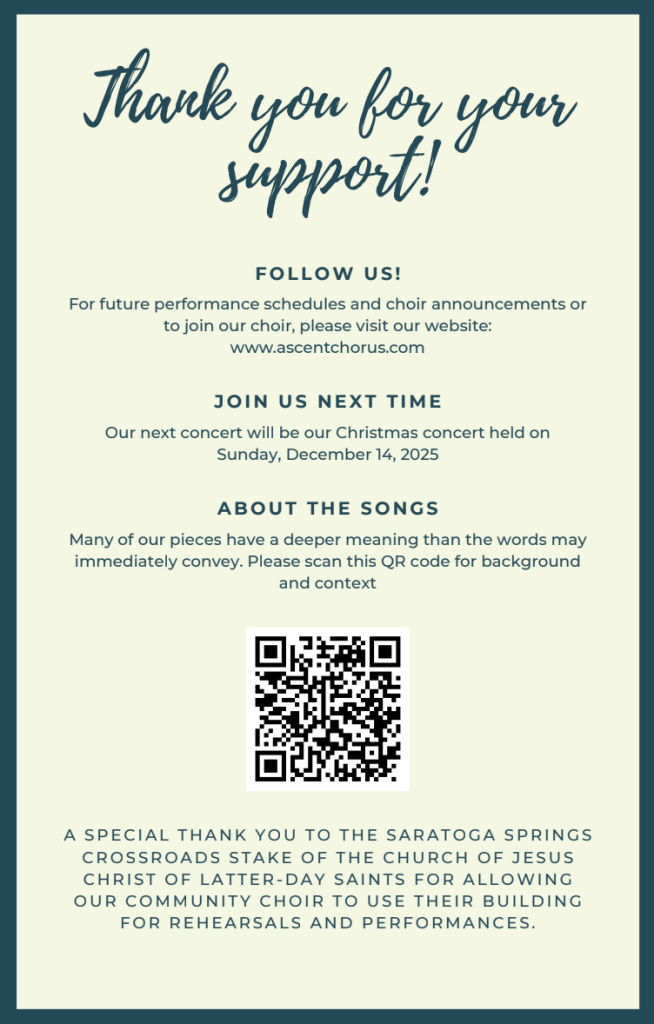
Our Concert in Context
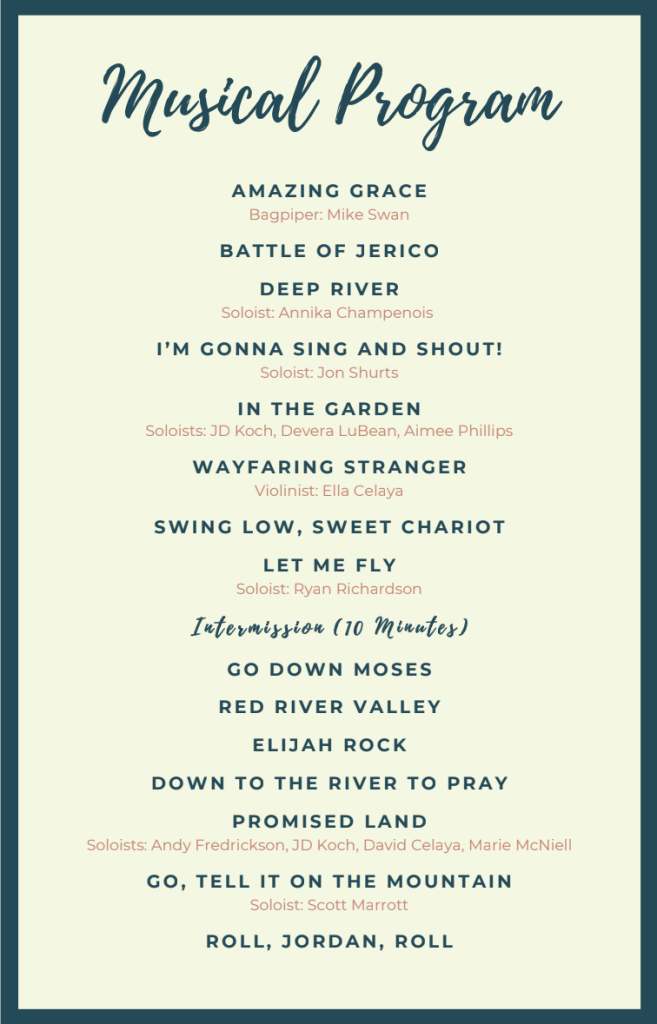
Amazing Grace – The lyrics of “Amazing Grace” convey a message of redemption and the joy of receiving God’s grace, even when you have done terrible things. No one understood this meaning more than the author, John Newton was a sailor involved in the African slave trade when a brutal storm hit his ship off the coast of Ireland. In that moment, he thought “…there never was, nor could be, such a sinner as myself.” This experience led to his spiritual conversation, and he later became an Anglican minister. His story came full circle in 1807 when he lived to see the slave trade abolished in the British Empire.
The Battle of Jericho – For the ancient Israelites, the Battle of Jericho was the final step away from their slavery in Egypt and towards freedom in a land of promise. This battle would not be won with weapons, but by their faith in their God. The Lord gave Joshua instructions, Joshua obeyed, and the walls to the city came down. For enslaved African-Americans, powerless to fight their enslavers, this story of victory without battle gave the encouragement to trust that God would also lead them to freedom.
Deep River – The River Jordan is a recurring theme in many spirituals. For the Israelites, it was one of the final obstacles that God would help them overcome in their journey to the Promised Land. In several spirituals, such as this one, the River Jordan has many meanings. It often symbolized the boundary between the weariness of mortality and an eventual heavenly home. Sometimes, it symbolized the ocean that kept the enslaved from their lost homelands in Africa. In coded discussions about escape, the River Jordan also acted as a code for the Ohio River, the boundary between slave and free states.
I’m Gonna Sing and Shout! – Mary McDonald was born in 1956 and learned to play hymns by ear when she was only five years old. Her studies and career have centered around sacred music. She has done several original compositions as well as arrangements of existing songs. This song features her original song of I’m Gonna Sing and Shout with the classic spiritual I’m Gonna Sing acting as the bridge.
In The Garden – This gospel song was written in 1912 by American songwriter C. Austin Miles (1868–1946). He was born in New Jersey and educated in Pennsylvania. Though he studied to be a pharmacist, he changed professions in 1892 to write gospel songs. He felt it was the way he could better serve God. The lyrics are written from the point of view of Mary Magdalene, reflecting on her witnessing the resurrected Savior, Jesus Christ in the garden area around the empty tomb.
Wayfaring Stranger – The origins of “The Wayfaring Stranger” are unclear. It has been connected to songs in both Scotland and Germany, but many Americans associate it with the Civil War. It was known as the “Libby Prison Hymn” because the words had been inscribed by a dying Union soldier in that Confederate prison in Virginia. Like many folk songs, many variations of the lyrics exist.
Swing Low, Sweet Chariot – The Biblical reference for “Swing Low, Sweet Chariot” comes from 2 Kings. Elijah used his mantle to smite the River Jordan. It parted so that he and Elias could cross on dry ground, just as it had parted for the ancient Israelites. “And it came to pass, as they still went on, and talked, that, behold, there appeared a chariot of fire, and horses of fire, and parted them both asunder; and Elijah went up by a whirlwind into heaven.” (2 Kings 2:11). The “home” could represent a heavenly kingdom, the Northern US and Canada, or Africa.
Let Me Fly – One of the folk stories that permeated amongst enslaved African-Americans was that their African ancestors had the gift of flight. This gift, passed down from generation to generation, was hidden and suppressed during the years of slavery. This idea was used as a secret language for runaway slaves and still inspires those looking for their own promised lands.
Go Down Moses – The story of Moses has been told every year for millenia during the Passover seder. However, due to the themes of bondage from slavery, it was a bible story that was not preached to enslaved African-Americans. This spiritual helped those who had heard the story in other open air church meetings pass it on orally to other enslaved people. It’s also strongly associated with Harriet Tubman, who used it as one of her code songs for the fugitives she helped to flee slavery. She was often referred to as “Moses” during her efforts in the Underground Railroad.
Red River Valley – While many think of the Red River Valley of the South when hearing this song, it was actually written about the Red River Valley of the North. That Red River forms the border between Minnesota and North Dakota and runs north into Manitoba, Canada. One Canadian folklorist claims that the song was written in the last 1800’s about an Indigenous Métis woman lamenting the departure of her Anglo lover. This lover was a soldier who came to the area with his company to suppress the Red River Rebellion.
Elijah Rock – While many parts of this spiritual have unclear symbolism, the obvious connection between the elements listed in the lyrics is that all the stories are found in the Bible. This was important as it was illegal to teach an enslaved person how to read or write. Preachers who were in favor of slavery used this to their advantage and purposely did not teach the enslaved people any of the Bible’s messages of empowerment. Instead, they focused on the passages about obedience and being good servants to masters. But some enslaved African-Americans had overheard the missing Bible stories as they came across other congregations meeting in outdoor services. They passed these stories orally through these songs, just as their ancestors passed on stories in Africa.
Down to the River to Pray (with Listen to Your Children) – The earliest written version of Down to the River to Pray was published in 1867 as part of Slave Songs of the United States. It rose in popularity after being featured in a baptism scene in the movie O Brother, Where Art Thou? in 2000. In this medley, its pairing with Ken Medema’s Listen to Your Children suggests that “when the people of the Lord get down to pray,” no matter what race they are, there is love, power, and grace.
Promised Land – Promised Land first appeared as part of a compilation of a hymns in London in the late 1700s. It was written by Samuel Stennett, an English Baptist minister in a time when the Church of England was the dominant religion. Full of biblical references, this song expresses the desire for a better, heavenly destination.
Go Tell It on the Mountain – One of the major reasons the songs of the enslaved found their way into mainstream culture was because of a group called the Fisk Jubilee Singers. As part of a fundraiser for Fisk University, this a capella ensemble of African-American singers left for an 18-month performance tour throughout the United States in 1871. As the tour progressed, more and more spirituals found their way into the concert repertoire. These songs, sacred to these students’ parents, were a reminder of the dark experiences of their ancestors during the days of slavery. Because of their reluctant willingness to perform these spirituals, including Go Tell It on the Mountain, we have them today.
Roll, Jordan, Roll – Roll, Jordan, Roll has its roots in an English Methodist hymn written by Charles Wesley, who also wrote Christ the Lord is Risen Today and Hark! The Herald Angels Sing. Enslaved African-Americans connected to his song’s message of hope for release from the struggles of life, and eventually it morphed via oral tradition into the version we know now.
2025 Spring Performances
Summerfield Retirement
Friday, June 6th @ 3:30pm and 7:15pm
904 N. 900 W., Orem UT
Spring Gardens Senior Living
Monday, June 9th @ 6:30pm MT
1483 W. 800 S. Street, Mapleton, UT 84664
Main Concert
Saturday, June 14th @ 7:00pm MT
368 Aspen Hills Blvd, Saratoga Springs, UT 84045
 Ascent Chorus